
House cleaning flat rate vs hourly: which is better?
Charge a flat rate for recurring cleans in homes you have already seen, and charge hourly (or a separate first-clean price) when you can't judge the job yet; most solo cleaners end up with a hybrid: first clean hourly, then a flat recurring price based on the time it really took.
Here's the thing nobody tells you when you start: the method matters less than the number underneath it. Flat rate is just hourly pricing where you carry the risk. If you know your hours, flat rate pays you for getting faster. If you don't, it quietly pays you less every time a house runs long.
Flat rate rewards speed. Hourly rewards honesty about the unknown.
Proof: quoting a clean in ScopeBid
ScopeBid lets you price first (type what the client pays) or cost first (enter labor and materials and get a suggested price). Each line can be hourly, per-person, crew, per-unit or area.
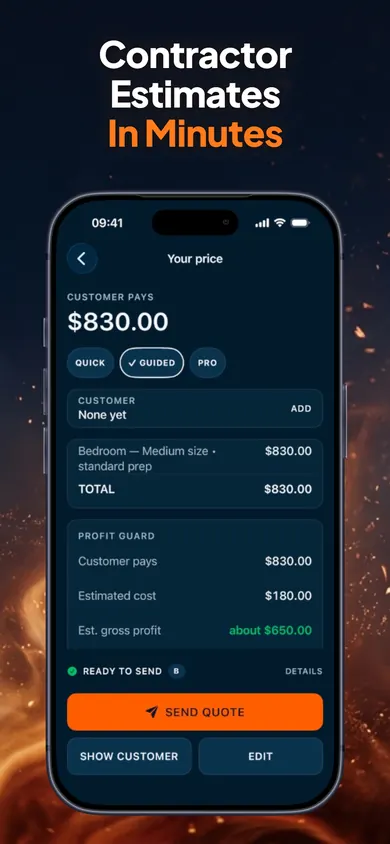
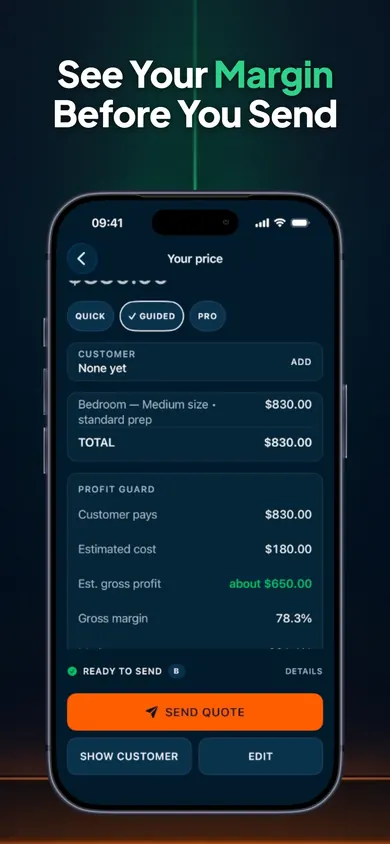
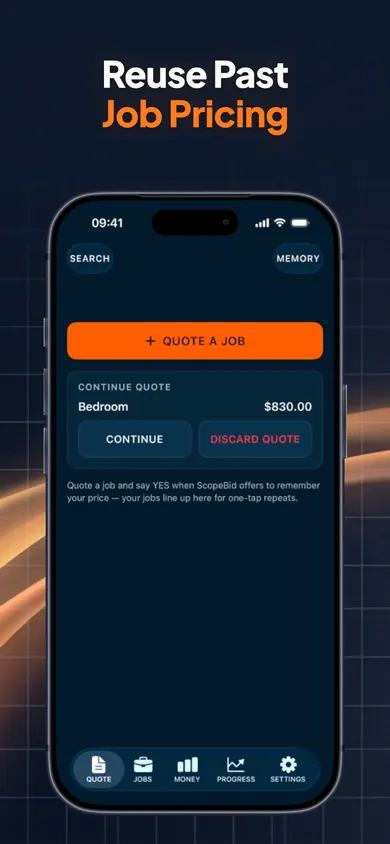
A biweekly three-bedroom, priced twice
Made-up numbers, for illustration only.
A cleaner charges $40 an hour. The first visit to a three-bedroom home takes 4.5 hours: crumbs in tracks, a neglected oven, the works. Billed hourly, that's $180, and nobody is surprised because she quoted a range.
The second visit takes 3 hours. She offers a flat $135 biweekly: three hours at her rate plus $15 for travel and supplies. By visit six she's down to 2.5 hours with the same checklist, so the flat price now pays her $54 an hour. The client likes knowing the number. She likes getting faster without getting paid less.
Then the family adopts a dog. Visits creep back to 3.5 hours: about $39 an hour. Because her quote listed "3 bed, 2 bath, no pets", she has a clean reason to re-quote.
Write the assumptions on the quote. They are your re-quote ticket.
Flat rate, hourly and hybrid, side by side
| Flat rate | Hourly | Hybrid | |
|---|---|---|---|
| Client knows the total | Before you start | After you finish | From visit two |
| If it runs long | You absorb it | Client pays | Client pays the first time |
| If you get faster | You earn more per hour | You earn less per visit | You earn more per hour |
| Best for | Recurring, known homes | Move-outs, deep cleans, unknowns | New recurring clients |
| Needs | Your real past times | Trust and a range | A timed first clean |
Honest limits
- ScopeBid is an estimating and invoicing app, not a booking or scheduling app, and not accounting or tax software. You set your own tax rates.
- It records payments (cash, cheque, e-transfer, bank transfer, card terminal) but does not process cards or move money.
- Your first 3 quotes are free, with full PDFs. Unlimited quoting, the full Business Memory and job costing need ScopeBid Pro, monthly or annual.
- It can't tell you what your market will pay. It remembers what you charged and what the job really cost.
Who should pick something else: if you want online booking, recurring scheduling and card payments in one place, a field-service platform built for cleaning companies will fit better. If you only clean two homes, a notes app and your phone timer are enough.
Test both methods on your next house
Set your hourly rate and the hours you expect. Then drag "it actually took" and watch what flat rate pays you per hour.
Flat quote$120you earn $40/hr
Hourly bill$120client pays for 3 hrs
Your numbers stay in this page; nothing is saved or sent.
Cleaning pricing questions
Is it better to charge flat rate or hourly for house cleaning?
Flat rate usually suits recurring cleans in homes you have already seen, because clients like a fixed total and you get faster with repeat visits. Hourly suits first cleans, move-outs and homes you cannot assess, because you are paid for every extra hour.
How do I turn an hourly rate into a flat rate?
Time the first clean, multiply the hours by your hourly rate, then add anything fixed like travel or supplies. Use that as the flat price for the next visits and re-check it every few months.
Should the first clean be priced differently?
Many cleaners price the first or deep clean separately, hourly or as a higher flat price, then move to a lower recurring flat rate once the home is under control.
What if a flat-rate clean takes much longer than expected?
That hour comes out of your pay. Put the assumptions in the quote (rooms, condition, frequency) so you have a fair basis to re-quote if the job changes.
Do clients prefer flat rate or hourly?
Clients generally find a fixed total easier to say yes to, because they know the cost before you arrive. Hourly can feel open-ended unless you give an estimated range.
Can ScopeBid quote both ways?
Yes. ScopeBid line items can be hourly, per-person, crew, per-unit or area, so you can quote a flat total, an hourly estimate, or both on one quote. Your first 3 quotes are free with full PDFs; ScopeBid Pro is needed for unlimited quoting.
Get ScopeBid free
One design decision we made: internal cost and margin are never printed on the client's PDF. Quote flat, quote hourly, keep your numbers to yourself.

Get ScopeBid free on the App Store · Updated November 2026
With care, Honest Little Apps
Related
- ScopeBid: the estimate and invoice app for contractorsQuote jobs from saved pricing, see your margin before you send, share a PDF and turn the approved quote into an invoice. Works offline.
- Estimate vs quote vs bid, and 9 more terms new contractors mix upEstimate, quote, bid, proposal, change order, markup vs margin: a plain glossary for new service pros, with a 20-second sorting game.
- Lawn care per cut vs monthly pricing, and your first weekPer cut or a flat monthly rate? A 3-tap picker, a converter that shows who carries the weather risk, and a 7-day plan for switching.
- Losing money on handyman jobs? Find the leakBusy but broke? Put one real handyman job into our free calculator and see where the money goes: drive time, materials, markup vs margin.