
Why am I losing money on handyman jobs?
Most handymen who lose money are not charging too little for the work itself; they are not charging for the hours around it: driving, buying materials and going back to fix things. A three-hour job that eats five hours of your day has a different price than the one you quoted.
Busy is not the same as profitable. A full calendar can hide a thin margin.
Proof: what ScopeBid shows before you send a quote
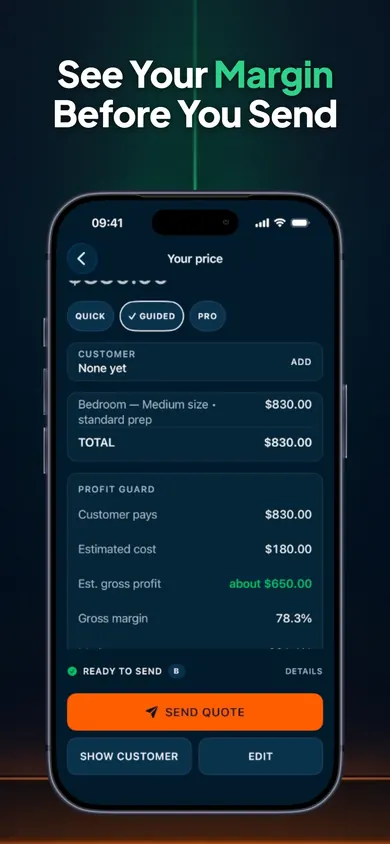
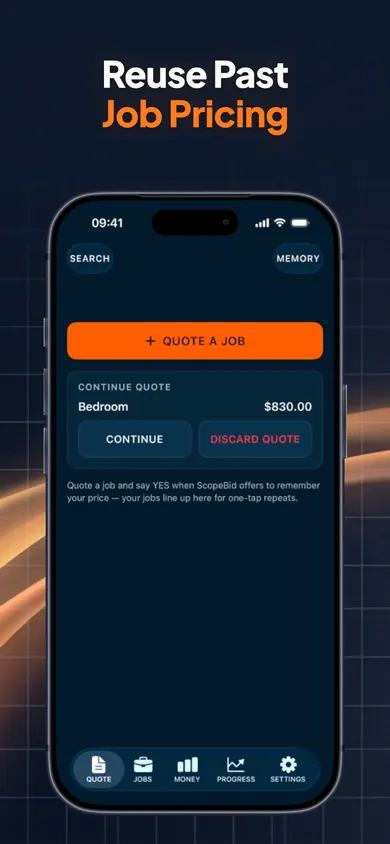
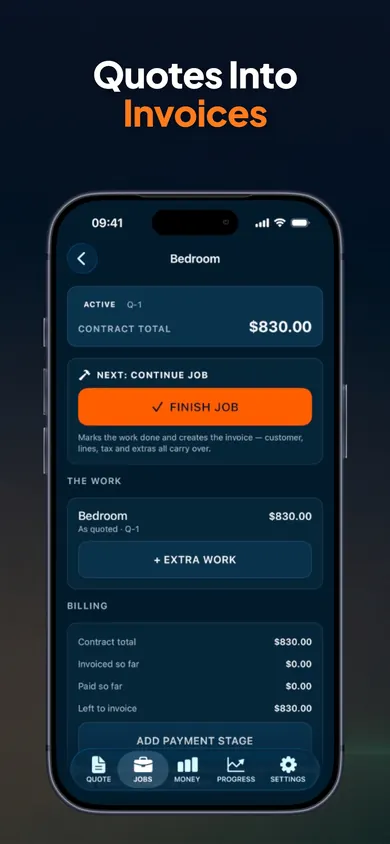
What the leak calculator tells you
The calculator at the top uses one rule: every hour the job takes from your day is a cost, whether or not it happened at the customer's house. With the example numbers (a $250 quote, three hours on site, $60 of materials, an hour and a half of driving and store runs, and a half-hour callback) here is how it reads:
| Counted | Cost | Gross profit | Margin |
|---|---|---|---|
| Only on-site hours + materials | $165 | $85 | 34% |
| Plus drive and store runs | $217.50 | $32.50 | 13% |
| Plus the callback | $235 | $15 | 6% |
Same job, same price. The margin you thought you had and the one you got are a long way apart. This is arithmetic on example numbers, not advice about what to charge.
The leak is rarely the hourly rate. It is the hours you never wrote down.
Markup vs margin: the handyman pricing mistake in one strip
Markup
Profit ÷ your cost. $200 cost + 50% markup = $300 price.
Margin
Profit ÷ customer price. That same $300 job is a 33% margin, not 50%.
In ScopeBid
Profit Guard shows both, side by side, and never counts sales tax as profit.
If you have been told to aim for a certain margin and you have been adding that percentage as markup, every quote has been lower than you meant. Neither number is right or wrong; they just are not interchangeable.
A Tuesday that looked like a good day
This is a made-up example, but the shape will be familiar. A handyman books three small jobs on a Tuesday: a door that sticks, two ceiling fans, and a drywall patch. Each is quoted from memory at a round number, and the day looks full and well paid.
The door needs a hinge he does not have, so there is a store run. The fans are fine, but the customer asks for a dimmer while he is there, and he does it without writing it down. The drywall patch needs a second visit for the second coat, which was never in the quote. By evening he has worked eleven hours for three jobs he priced as six.
Nothing went wrong, exactly. The jobs were done well. The quotes just did not include the store run, the extra dimmer or the second visit. Next time the same three jobs come up, the only thing that will change the result is a record of what they actually took.
You cannot fix a price you cannot remember.
How to stop losing money on small jobs, in 3 steps
- Price the whole job, not just the work. Add trip charges, minimums and materials from a price book so they are not left to memory. ScopeBid keeps a local price book of services, materials, trip charges and minimums.
- Check margin before you send. Profit Guard shows customer price, direct cost, estimated gross profit, gross margin and markup. Type a discount and see what it does to the margin. You can set a minimum-margin warning and still override it.
- Close out every job. When the job ends, enter actual labor and materials in about ten seconds. ScopeBid compares quoted with invoiced and estimated with actual cost, and saves it in Business Memory for the next similar quote.
One design decision we made: internal cost and margin are never printed on customer documents. You see the numbers that protect your business; the customer sees a clean PDF quote with your logo and terms.
Honest limits
- ScopeBid records payments; it does not process cards or move money.
- It is an estimating and invoicing tool, not accounting or tax software. You set your own tax rates.
- Three quotes are free. Unlimited quoting, Business Memory, job costing and invoicing need ScopeBid Pro.
- It is for owner-operators. If you dispatch a crew from an office, a full field-service platform will fit better.
Make it a habit with ScopeBid
Quote your next job from a real past one, check the margin before you send, and close it out when you pack up. Works offline, no account. Get ScopeBid on the App Store.

Handyman pricing questions
Why am I losing money on handyman jobs when I'm always busy?
Usually because the quote covers the time on site but not the time around it: driving, buying materials, returns to the store, and callbacks. Small jobs suffer most because that fixed time is a big share of a short job. A trip charge or minimum and an honest look at past jobs are the usual fixes.
What is the difference between markup and margin?
Markup is profit divided by your cost; margin is profit divided by the price the customer pays. A 50% markup on $200 of cost gives a $300 price and only a 33% margin. Mixing them up is one of the easiest ways to underprice.
Should I charge a trip fee or a minimum?
Many service businesses use a trip charge or job minimum so short visits still cover travel and setup. ScopeBid's price book has room for trip charges and minimums alongside services and materials. What you charge is your call and depends on your market.
How do I know what a job really cost me?
Write down actual labor hours and materials when the job ends, then compare them with the quote. ScopeBid's ten-second closeout does this and feeds the result into Business Memory for your next similar quote.
Does ScopeBid tell me what to charge?
Not exactly. If you price cost first, it suggests a price from your labor and materials. If you price first, it shows estimated gross profit, gross margin and markup so you can judge. You set the final number.
Is ScopeBid free?
Your first 3 quotes are free, with full PDFs. ScopeBid Pro, billed monthly or annually, adds unlimited quoting plus the full Business Memory, job costing and invoicing workflow. Prices for your country show in the app before you buy.
Related
- ScopeBid: the estimate and invoice app for contractorsQuote jobs from saved pricing, see your margin before you send, share a PDF and turn the approved quote into an invoice. Works offline.
- Estimate vs quote vs bid, and 9 more terms new contractors mix upEstimate, quote, bid, proposal, change order, markup vs margin: a plain glossary for new service pros, with a 20-second sorting game.
- When a customer says your painting quote is too highA painter's FAQ for the 'too expensive' reply: see what a discount does to your profit in one tap, then answer with scope, not panic.
- What to include in a car detailing estimateThe 12 lines every car detailing estimate needs, from vehicle size to condition fees. Free checklist with a score, plus how to send it from iPhone.