Notebook
Free and private. Easy to forget a shift, and you do the overtime math yourself.
 Pay stub glossary · U.S. and Canada
For hourly and shift workers: scratch a code to see what it means and whether it counts as pay.
Sample stub, made-up figures
Tap a code to scratch it.
 Free on iPhone · no account, no bank login
Pay stub abbreviations are short codes for three kinds of line: what you earned (REG, OT, HOL), taxes withheld (FIT, OASDI, MED, or CPP and EI in Canada) and other deductions you agreed to (401K, union dues). Read the earnings lines first: they are the ones you can check against your own hours.
Earnings you can check. Taxes you can ask about. Deductions you signed up for.
Most are short codes for three things: what you earned (REG, OT, HOL), taxes taken out (FIT, OASDI, MED, or CPP and EI in Canada) and other deductions (401K, union dues). The glossary on this page lists 34 of them.
Old-Age, Survivors and Disability Insurance, better known as Social Security. The IRS says the employee rate is 6.2%, up to a yearly wage base ($184,500 for 2026).
Year to date: the running total of that line since January 1. It is useful for checking that every pay period was actually counted.
Net is gross minus income tax, Social Security, Medicare (or CPP and EI in Canada) and any deductions you signed up for. The gap is normal; whether each amount is right is a question for payroll or a tax professional.
Often because overtime is counted per workweek, not per pay period. The U.S. Department of Labor says hours cannot be averaged across two or more weeks. Ontario's threshold is 44 hours a week, not 40.
Taxes are required by law (income tax, Social Security, Medicare, CPP, EI). Deductions are usually things you chose or agreed to, like retirement savings, insurance premiums or union dues.
No. You type the figures from your statement into EarnCheck, and it compares gross with gross, line by line. It does not calculate taxes or deductions.
Rates from the IRS Topic 751 on Social Security and Medicare withholding (2026) and About Form W-4. CPP and CPP2 from the Canada Revenue Agency CPP page. Codes vary by payroll provider; your stub may use other spellings.
If a code is not here, payroll can tell you what it means. Asking is normal.
Picture a warehouse worker on nights. Two weeks, 45 hours each week. The stub shows REG 83.50 and OT 6.50. All 90 hours are paid, but they were expecting 10 hours of overtime. Are 3.5 overtime hours missing?
Maybe not. If the employer's workweek starts on Wednesday and the shifts straddle it, the 90 hours can split into workweeks of 46.5 and 43.5, which gives exactly 6.5 hours of overtime. The U.S. Department of Labor overtime page says a workweek can begin on any day and hours cannot be averaged across weeks. In Ontario the overtime threshold is 44 hours a week, so the same schedule would show no overtime at all.
The right move is not to assume an error. Write down each shift, check which workweek it falls in, then ask payroll with the figures in hand.
A difference is something to review, not proof of a mistake.
Free and private. Easy to forget a shift, and you do the overtime math yourself.
Flexible. You build the overtime rules, the workweek split and the premiums by hand.
We make it. Confirm shifts in one tap, then compare regular, overtime and premiums with your statement. Deductions stay separate.
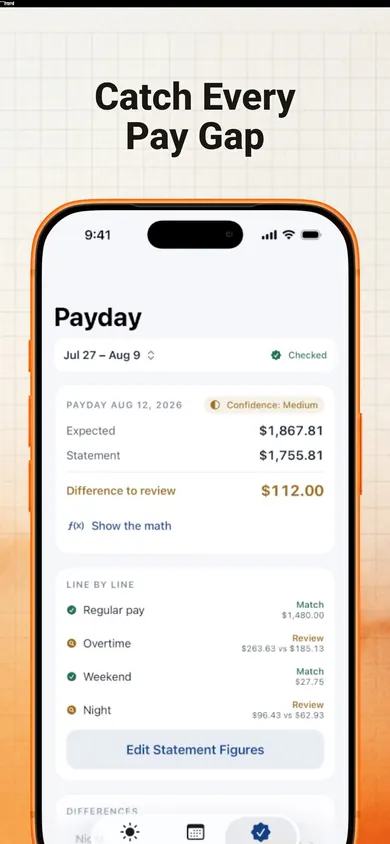
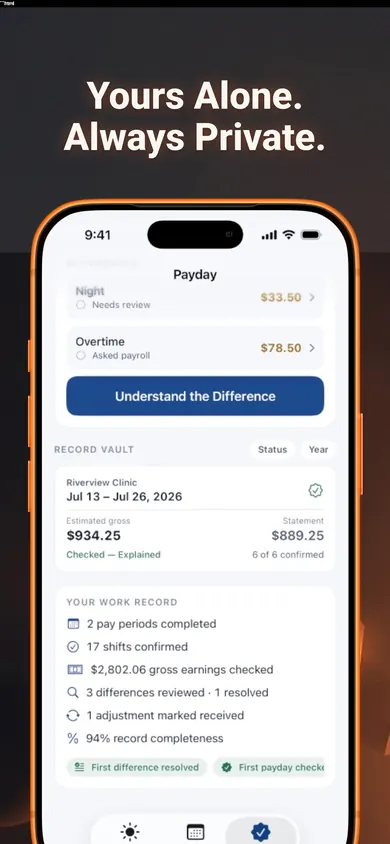
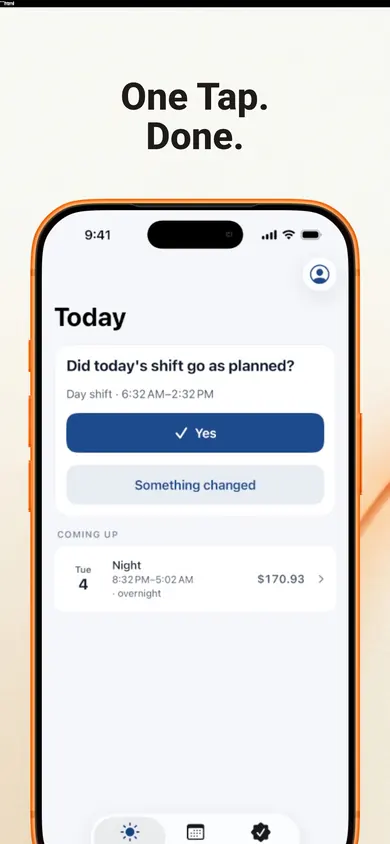
Keep your own record of every shift, then check the earnings lines on your next stub. No account, no bank login.
Download EarnCheck free on the App Store
Updated November 2026