
Short answer
Do nurses get overtime after 12 hours?
Usually not for the 12 hours alone: under the federal rule, a nurse gets overtime for hours over 40 in a workweek, so three 12-hour shifts (36 hours) earn none. The big exception is the hospital “8 and 80” system, where hours over 8 in a day are overtime. Your state or union contract can add more. Which rule you are on decides everything below.
Updated November 2026 · Sources: U.S. Department of Labor fact sheets, linked in each fact.
Chapter 1
Six nurse overtime myths, checked
Break-room wisdom is half right, which is the dangerous half. Here is each claim next to what the Department of Labor actually says.
“A 12-hour shift is four hours of overtime.”
Fact: The federal rule counts the workweek, not the day: time and a half for hours over 40 (DOL Fact Sheet #56A, revised December 2019). Thirty-six hours across three shifts is straight time. A few states have daily overtime of their own; check your state labor department.
“Hospitals can't pay overtime by the day. That's a rumor.”
Fact: Hospitals and residential care establishments may use a fixed 14-day period with a prior agreement, paying time and a half for hours over 8 in a workday and over 80 in the 14 days (Fact Sheet #54, revised July 2009). On that system, every 12 has four overtime hours.
“Nurses are professionals, so we don't get overtime.”
Fact: The DOL says registered nurses paid by the hour should receive overtime pay, and LPNs generally don't qualify for the professional exemption (Fact Sheet #17N, revised September 2019). The exemption question is about salaried RNs paid at least $684 a week.
“If I stay under 80 hours in the pay period, there's no overtime.”
Fact: Only on 8 and 80. On the usual 40-hour week, each workweek stands alone, so 48 hours plus 32 hours is still 8 overtime hours (Fact Sheet #56A).
“Overtime is time and a half of my base rate.”
Fact: It is time and a half of the regular rate, and night shift differentials go into that rate (29 CFR 778.207(b)). Nights make each overtime hour worth more than base pay times 1.5.
“On 8 and 80 you get paid overtime twice for the same hours.”
Fact: Daily overtime premiums can be credited toward the overtime due over 80 hours (29 CFR 778.601). An hour is not paid as overtime twice.
One sentence to remember: the shift length matters only if your employer uses daily overtime; otherwise the workweek does.
Chapter 2
Honest limits: what EarnCheck does with nurse overtime
- Free version: one job, a complete first pay period with unlimited shifts, weekly overtime (U.S. federal 40-hour preset, Ontario 44-hour preset or your own agreement) and a payday comparison.
- Pro: daily overtime, double time and night, weekend or holiday premiums you define, unlimited pay periods and more than one job. Monthly or annual plans.
- No 8 and 80 preset. The listing doesn't name one. Daily overtime is there in Pro; check the 80-hour line yourself.
- Gross only. No taxes or deductions, not a payroll system, not legal advice.
We would rather tell you this now than have you find it on payday.
Chapter 3
How to check your 12-hour shift overtime in 3 steps
- Set your rule and your real workweek. Pick the U.S. federal 40-hour preset and set the day your employer's workweek starts, even when it differs from your pay period. Each preset links its official source.
- Confirm each shift. One tap when it went as planned, or fix the start, end or unpaid break. A 7 p.m. to 7:30 a.m. shift stays one shift across midnight.
- Compare payday line by line. Type in your statement figures. Regular is matched with regular, overtime with overtime, premiums with premiums.
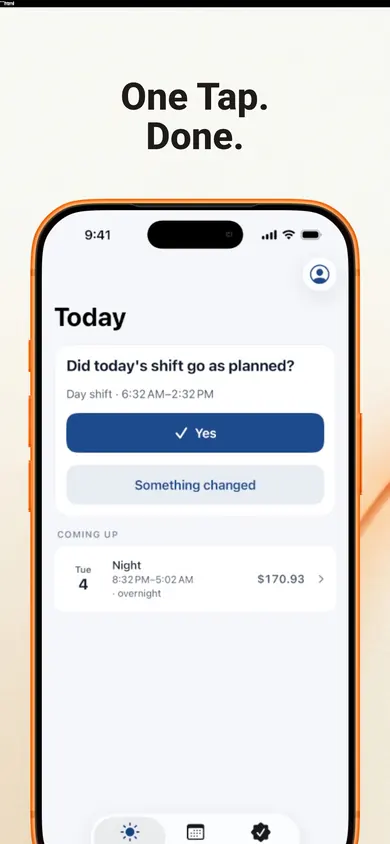
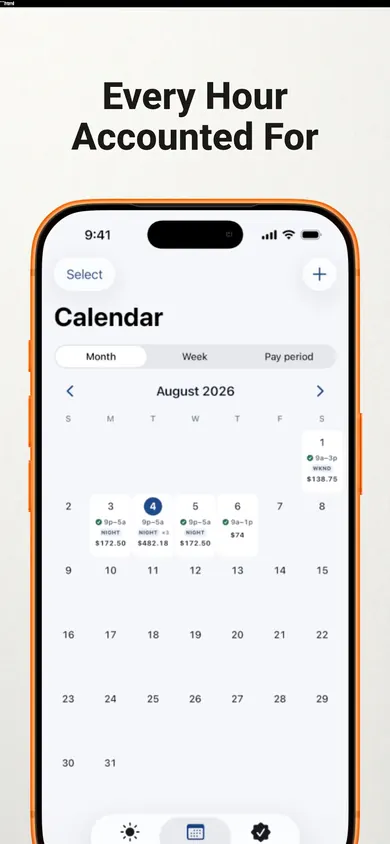
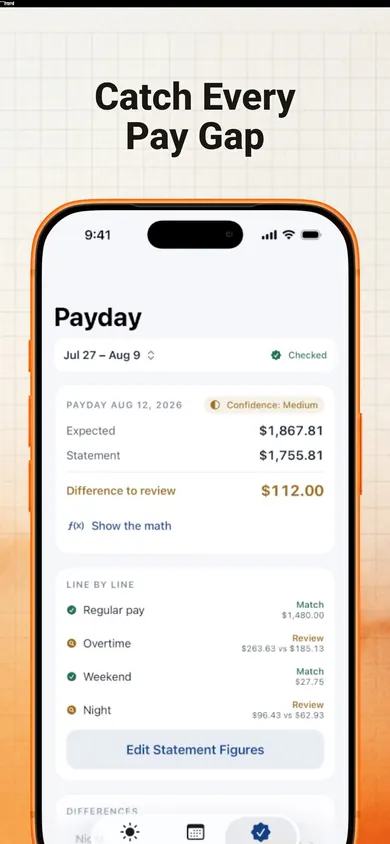
A design decision we made: scheduled shifts never count until you confirm them. A schedule is a plan. Your record should be what happened.
Chapter 4
Worked example: one nurse, 14 days, two overtime rules
A med-surg nurse works her three 12s, picks up a fourth in week one, then works three in week two. 84 hours. Here is what each rule owes, before any differential.
| Week 1 | Week 2 | Overtime hours | |
|---|---|---|---|
| Hours worked | 48 | 36 | — |
| 40-hour workweek | 8 over 40 | 0 | 8 |
| 8 and 80 (daily part) | 4 shifts × 4 | 3 shifts × 4 | 28 |
| 8 and 80 (80-hour part) | 84 − 80 = 4, credited by the daily overtime | 0 extra | |
Same 84 hours: 8 overtime hours on one rule, 28 on the other. That is why the first question to payroll is “which rule am I on?”
Chapter 5
Who EarnCheck is not for
- Salaried, exempt nurses: there is no hourly overtime to check.
- Anyone who wants take-home pay after taxes. EarnCheck stops at gross.
- Nurses who want the app to talk to payroll. It never contacts your employer; it gives you a neutral message to copy and edit.
- Android users. It is iPhone only.
If your hospital already gives you a clear timecard with overtime split by rule, a paper notebook may be all you need.
Nurse overtime questions
Is a 12-hour shift automatically overtime for nurses?
No. Under the standard federal rule, overtime is owed for hours over 40 in a workweek (DOL Fact Sheet #56A, revised December 2019). Three 12-hour shifts is 36 hours, so no federal overtime. A hospital using the 8 and 80 system, or a state or contract rule, can change that.
What is the 8 and 80 rule for nurses?
Hospitals and residential care establishments may use a fixed, recurring 14-day period instead of the 40-hour workweek, if they have an agreement with employees before the work is done. Overtime is then due for hours over 8 in a workday and over 80 in the 14 days (DOL Fact Sheet #54, revised July 2009).
Are hourly nurses exempt from overtime?
The Department of Labor says registered nurses paid by the hour should receive overtime pay, and LPNs generally do not qualify for the professional exemption (Fact Sheet #17N, revised September 2019). A salaried RN paid at least $684 a week may be classified as exempt.
Does my night differential change my overtime rate?
Usually yes. Federal regulation 29 CFR 778.207(b) says night shift differentials are included in the regular rate, so time and a half is figured on the higher blended rate, not on base pay alone.
How do I know if my hospital uses 8 and 80?
Ask payroll or HR which overtime period applies to you, and check your offer letter, handbook or union contract. The 8 and 80 system needs an agreement made before the work, so it should be written down somewhere you can see.
Can EarnCheck calculate 8 and 80 overtime?
Not as a named preset. The free version uses weekly overtime (the U.S. federal 40-hour rule, Ontario's 44-hour rule or your own agreement). Daily overtime is part of EarnCheck Pro. The 80-hours-in-14-days part is not listed as a rule, so check that line yourself.
Does EarnCheck tell me if I was underpaid?
No. It estimates gross pay from the hours and rules you enter and marks each line Match, Difference to Review or Incomplete Information. A difference is something to ask about, not proof of an error. This is not legal advice.
General information from U.S. federal sources, not legal advice. Your payroll team, union or state labor department can confirm what applies to you.
Count your next 14 days before payday
Confirm each 12 as you finish it, then compare the stub line by line. Open EarnCheck in the App Store and start with the free first pay period.

Related
- EarnCheck: the shift and pay tracker for iPhoneLog shifts, see your estimated gross pay with overtime, then compare it line by line with your pay statement. No account, no bank login.
- Auto-deducted lunch, but you worked through itYour 30-minute lunch was auto-deducted but you answered call lights through it. Follow a 4-question flowchart built on U.S. Labor Department rules.
- How to track shift differential hoursNight differential hours are easy to lose on a stub. What to log each shift, a worked overtime example, and a 3-tap check. Estimates, not advice.
- Worked 80+ hours in a pay period and got no overtime?Overtime is counted per workweek, not per two-week pay period. See why 80 hours can still owe overtime, and how to check your pay stub calmly.