
How do you check if your first paycheck is correct?
Compare gross with gross for the same dates: your own record of hours times your rate, plus any overtime, against the gross pay on your stub for that pay period. Do it before looking at deductions. A first check often looks short for a boring reason: the pay period ended before your last shifts, so those hours ride on the next check.
Your own record turns “I think I'm short” into “these two lines differ by six hours.”
Who this guide is not for
- Salaried employees. This is built around hourly pay and hours worked. Salaried pay is checked differently.
- Anyone who needs tax or net-pay math. We only estimate gross pay. Taxes and deductions are a separate question.
- Gig and contract workers paid per job. Independent contractors are not covered by the same hours-worked rules.
- Anyone with a dispute already under way. Talk to your state labor office or the U.S. Department of Labor's Wage and Hour Division (1-866-487-9243).
Your first week, day by day
The result of the counter above is only as good as the record behind it. Here is what to note on each day of a new job.
- Day 1, orientation counts. Write down the start and end time, even for paperwork and training. Training is work time under federal law unless four strict conditions are all met (DOL Fact Sheet #22 (revised July 2008)).
- Day 2, ask three questions. When does the workweek start? When does the pay period end? When is payday? The workweek need not match the calendar week (DOL Fact Sheet #23 (revised October 2019)).
- Day 3, learn the break rules. Short rest breaks of 20 minutes or less are paid; a real meal break, typically 30 minutes or more with no duties, generally is not (DOL Fact Sheet #22 (revised July 2008)).
- Day 4, note anything unusual. Stayed late to finish a task? Started early? Those hours count. Write them down the same day.
- Day 5 to 7, total the week. Over 40 hours in that workweek means federal overtime at no less than time and a half, unless your job is exempt.
- Payday, compare line by line. Match the dates on the stub to your record. Employers must record hours worked each day and each workweek, and the pay period each payment covers (DOL Fact Sheet #21 (revised July 2008)).
Ways to keep your own hours record
We make EarnCheck, so take the last column with that in mind. Any of these beats memory. The point is to have a record that belongs to you.
What EarnCheck does on payday
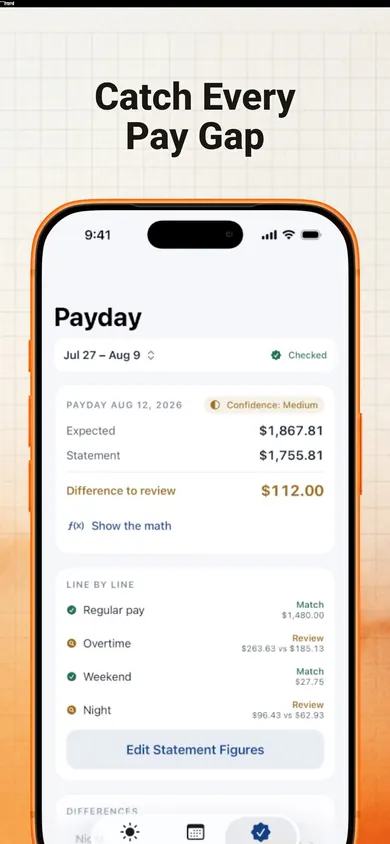
You enter the figures from your pay statement and EarnCheck compares regular with regular, overtime with overtime, premiums with premiums. Each line is marked Match, Difference to Review or Incomplete Information. Deductions are kept separate and never counted as missing pay.
One design decision we made: scheduled shifts are never counted until you confirm them, because a schedule is a plan, not a record. And overnight shifts stay one shift when they cross midnight.
Honest limits
- EarnCheck estimates gross pay from the hours and rules you enter. It does not calculate taxes or deductions, is not a payroll system, and does not give legal advice.
- A difference is something to review, not proof of an error. Your payroll team or labor authority can confirm what applies to you.
- The free version covers one job and one complete pay period. EarnCheck Pro Monthly is $2.99 and EarnCheck Pro Annual is $19.99, with a 7-day free trial on the annual plan for eligible customers.
- The counter on this page uses the U.S. federal 40-hour weekly rule only. State daily overtime rules are not included.
First paycheck questions
Why is my first paycheck less than I expected?
The most common reason is timing: the pay period closed before your last shifts, so those hours land on the next check. Other reasons are an unpaid meal break, a different rate during training, or deductions. Compare gross with gross for the same dates before assuming an error.
Should orientation and training be paid?
Under federal law, training time counts as work unless all four conditions are met: it is outside normal hours, voluntary, not job related, and no other work is done, per DOL Fact Sheet #22 (revised July 2008). State law can add more.
Are breaks paid?
Short rest breaks, usually 20 minutes or less, count as hours worked. Bona fide meal periods, typically 30 minutes or more when you are fully relieved of duty, generally do not, according to DOL Fact Sheet #22 (revised July 2008).
When does overtime start on a new job?
Under the federal rule, after 40 hours in a workweek, at not less than time and a half. The workweek is a fixed 168-hour period that may start on any day, and hours cannot be averaged across weeks (DOL Fact Sheet #23 (revised October 2019)). Your state may have a different rule.
How long can my employer wait to pay me?
Pay frequency is set by state law, not federal law. DOL's State Payday Requirements table lists the rule for each state. Overtime earned in a workweek is normally paid on the regular payday for that period (DOL Fact Sheet #23 (revised October 2019)).
What if my paycheck really is wrong?
Start with payroll or your manager and bring your own record. If it is not resolved, the U.S. Department of Labor's Wage and Hour Division (1-866-487-9243) takes complaints; state labor offices do too. This page is general information, not legal or payroll advice.
Is EarnCheck free for a first paycheck?
Yes. The free version covers one job and a complete first pay period with unlimited shifts, weekly overtime and a payday comparison. EarnCheck Pro, at $2.99 a month or $19.99 a year on the App Store, adds more pay periods, multiple jobs, advanced overtime and premium rules, and full exports.
Try it tonight
Log today's shift in one tap, and your first payday arrives with a record of your own.

Try EarnCheck tonight on the App Store
Updated November 2026 · general information, not payroll or legal advice
Related
- EarnCheck: the shift and pay tracker for iPhoneLog shifts, see your estimated gross pay with overtime, then compare it line by line with your pay statement. No account, no bank login.
- Auto-deducted lunch, but you worked through itYour 30-minute lunch was auto-deducted but you answered call lights through it. Follow a 4-question flowchart built on U.S. Labor Department rules.
- Worked 80+ hours in a pay period and got no overtime?Overtime is counted per workweek, not per two-week pay period. See why 80 hours can still owe overtime, and how to check your pay stub calmly.
- Which app to track hours worked and pay? A 3-tap pickerThree taps match your job to an hours-and-pay tracker: the free DOL-Timesheet app, a notebook, or EarnCheck. Honest limits, DOL sources.